

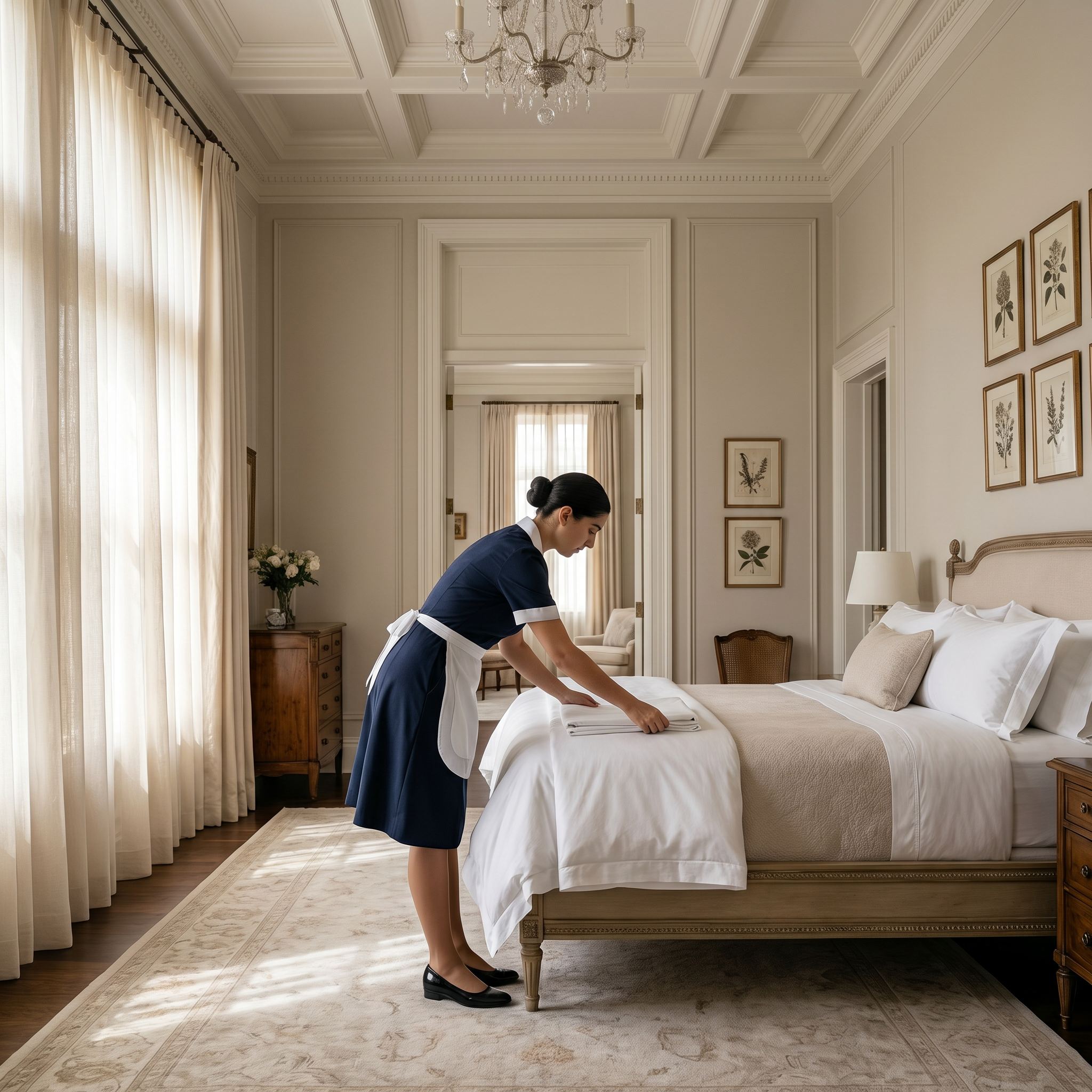
The Issue Is Almost Never the Housekeeper
At My Household Managed, one of the most consistent patterns we see across household sizes, home types, and staffing arrangements is families finding an excellent housekeeper and then wondering why things inside the home still feel off. Items end up in piles. Other items go misplaced. The home feels cleaner but not quite right. And eventually, the search starts again.
The issue, in most cases, is not the housekeeper. It is the onboarding.
This guide walks through what housekeeper training actually looks like in a private household, why it matters regardless of your housekeeper’s experience level, and how to structure the communication that makes a long-term working relationship thrive.
Maid Service vs. Private Housekeeper: Understanding the Difference
The terms maid, cleaning service, and housekeeper are used interchangeably in everyday conversation, but they describe meaningfully different categories of work. Understanding the distinction matters before you hire, because the expectations that come with each role are not the same. For a deeper breakdown, see our guide on housekeeper vs. maid services.
A maid service or cleaning service operates on surface cleaning. A team arrives on a schedule, moves efficiently through the home, wipes down counters, cleans bathrooms, vacuums floors, and leaves. Deep cleaning, including moving furniture to clean behind it, removing fingerprints from glass surfaces, cleaning inside appliances, or addressing the built-up grime in less visible areas, is typically an add-on service billed separately or scheduled as an occasional extra. The team is trained to a standard, but that standard applies uniformly across every home they service. They are not there to learn yours.
A private housekeeper works in one home. She is not cycling through a client list or working to a commercial checklist. Her job is to understand how your household functions, maintain your specific standards, and build a working knowledge of your routines, preferences, and organizational systems. She will clean behind the couch. She will meticulously remove fingerprints from glass. She will notice that something is off and address it without being asked, because she knows your home.
The housekeepers My Household Managed works with are career private service professionals. They come from private household backgrounds: formal estates and principal residences. They are not transitioning from commercial cleaning companies, maid services, or hotel housekeeping. Their experience is reflected in their professional profile and their compensation expectations.
A Skilled Housekeeper Still Needs Your Input
Career housekeepers are professionals with deep expertise. They understand specialty cleaning products and when to use them. They know how to remove stains from delicate fabrics, maintain antique surfaces, care for fine art, work around staff and family schedules, and establish systems for seasonal deep cleaning. Housekeepers who have worked in formal estates have cleaned homes where heads of state are entertained. The knowledge base is substantial.
However, none of that expertise tells them where you keep your children’s art supplies, which figurines your daughter will notice are missing, or that you prefer your kitchen cleared by zone rather than by surface. Those details live in your household and nowhere else. Even the most accomplished housekeeper arrives at your home without them.
This principle applies across every role My Household Managed places, including estate managers, house managers, nannies, butlers, and personal assistants. The professional brings their skillset and they must be given the context of how to apply it to your preferences.
Who Is Responsible for Training the Housekeeper
In a fully staffed household, a house manager or estate manager typically takes responsibility for onboarding and training the housekeeping team. They communicate the principal’s standards, document household systems, manage scheduling and task prioritization, and serve as the point of escalation when questions arise. The principal sets the vision. The house manager translates it into daily operations. In a single-housekeeper household, that responsibility falls to the principal directly. There is no intermediary, and the investment of time at the beginning pays dividends throughout the working relationship.
The Two Most Common Housekeeper Frustrations
When families come to us looking to replace a housekeeper or resolve ongoing frustrations, the issues almost always fall into one of two categories.
The housekeeper moves things into piles instead of putting them away.
The housekeeper puts things away, and no one can find anything afterward.
Both problems have the same root cause. The housekeeper was never given a clear framework for where things belong.
Consider the reality of a busy household at 9 AM. A family is getting children to school, managing work calls, or navigating a chaotic morning. By the time the housekeeper arrives, there may be clutter on the counter, toys throughout the living room, and laundry in three different stages of completion. Before any cleaning can begin, those items need to be addressed.
If there is no established system for where things go, a housekeeper faces a genuine problem. She does not want to make assumptions. She does not want an item to go missing and be blamed for it, particularly if valuables are visible. She does not know whether the pile of small toys your child collected from a birthday party is something to keep or something that can quietly disappear. So she creates a pile. She leaves it somewhere you can see it. She signals to you: these need your decision.
A pile is not carelessness. It is professional caution in the absence of information.
The inverse problem, items put away in the wrong places, comes from a housekeeper who is trying to help but guessing at your system. Both situations are resolved the same way: a clear conversation early, and an ongoing culture of communication.
What a Housekeeper Training Guide Should Cover
Training your housekeeper is about giving her the information she needs to maintain your home the way you want it maintained. That spans products, processes, timing, and communication, and each category matters.
The Daily Rhythm of Your Household
Walk your housekeeper through what a typical day looks like. Are you working from home and need the office left until mid-morning? Do children return at 3 PM and create a second wave of activity? Is there a regular evening where the main floor needs to be reset for dinner? Knowing the rhythm helps her sequence her work intelligently. If your household does not have a predictable rhythm, that is equally useful information. She should know to read the day as she finds it and prioritize accordingly.
A Cleaning Schedule by Cadence: Daily, Weekly, Monthly, Seasonal, and Annual
Effective household maintenance runs on a layered schedule, and your housekeeper training guide should make each cadence explicit. Daily tasks, like resetting living spaces, managing laundry, and maintaining kitchen cleanliness, run alongside weekly tasks such as thorough bathroom cleaning, floor care, and linen changes. Monthly tasks, including appliance maintenance, deep organizing, and interior window cleaning, sit alongside quarterly or seasonal work like rotating linens and soft goods, deep cleaning storage areas, and switching out seasonal items.
Annual tasks round out the full picture: deep cleaning behind large appliances, washing drapery, conditioning leather, and a full inventory of household supplies and equipment. Martha Stewart’s complete home cleaning schedule is a useful reference point for understanding the scope of tasks that fall across each of these cadences. For a private housekeeper, this kind of structure is the starting framework. Your housekeeper then learns which tasks belong to which cadence within your specific home and how to plan her weeks so that routine work and periodic deep work do not compete for the same hours.
Organizational Logic and Where Things Belong
Go through your home room by room with your housekeeper and establish where categories of items live. This does not need to be exhaustive. The goal is to give her enough of a framework to make reasonable decisions independently. Address scenarios she is likely to encounter: the items your children leave in unexpected places, the counter that collects mail and miscellaneous objects, the areas where clutter tends to gather. Tell her explicitly what to keep, what to fold into a neat pile, and what can be discarded.
If your home has more items than available storage allows, that is worth naming directly. When physical space is insufficient, a housekeeper cannot organize what has no home. Decluttering may be a prerequisite to the organizational standard you are hoping for.
Standards of Presentation
Some of the most meaningful housekeeper training covers the details that define the look and feel of a well-maintained home. These are the standards a career housekeeper takes seriously and that principals rarely think to articulate until something feels off.
How should the bed be made, and how should the pillows be arranged? Should the toilet paper be folded into a precise pattern when a roll is replaced, and if so, which pattern? How should hand towels be hung in the bathroom? In what manner are linens folded and stored in the closet? How are surfaces set after cleaning, and are there decorative objects that should always return to a specific position?
These details are what distinguish a cleaned home from a maintained one. Walking through them once at the start means they become consistent practice rather than an ongoing source of small frustrations.
Priority Zones and Non-Negotiables
Let her know which rooms or areas carry the highest priority. If you frequently entertain and the main living areas need to be impeccable above all else, say so. If the master suite is your sanctuary and you want it finished even if another room does not get completed that day, tell her. This allows her to triage intelligently when time runs short rather than guessing at what you value most.
Working Around People in the Home
Your housekeeper is working in a living, breathing household. Children are playing. Adults are taking calls. Someone may be sleeping. She will need to read the room, adjust her sequence, and sometimes return to a space she skipped earlier. What helps her exercise that adaptability is knowing your preferences in advance: whether she should check in before entering a room with a closed door, whether certain hours are off-limits for vacuuming, or whether she should move through the home without drawing attention.
Added Tasks and Scope Changes
Many households ask their housekeeper to assist with tasks beyond regular cleaning: ironing, light meal prep, readying a guest suite before visitors arrive, or running a load of laundry. Laundress services are a dedicated specialization for households with significant wardrobe care needs, but in many homes, the housekeeper handles laundry as part of her regular scope.
The piece that matters is communication. If the laundry unexpectedly doubled this week, or the guest suite needs to be prepared for an early arrival, the regular cleaning schedule will be affected. Making it safe for your housekeeper to tell you what she did not finish, and why, is one of the most valuable things you can establish at the start of the relationship. A housekeeper who can say “the ironing is set aside for Thursday because the guest suite took priority today” is working in partnership with you.
When to Raise an Issue and When to Ask for Guidance
Your housekeeper needs to know the communication protocol for your household. Some questions she should handle independently. Others warrant a check-in. Still others require a principal’s decision. Define the threshold clearly. If she notices a maintenance issue while cleaning, should she send a text, leave a note, or flag it to the house manager? If a task will not be completed that day, when and how should she communicate that? Establishing these pathways early means small issues are addressed before they become larger ones.
Inventory, Supplies, and Restocking Systems
A well-run household stays ahead of supply needs. Your housekeeper should know how your inventory system works: where cleaning products, laundry supplies, and household consumables are stored, what the par levels are for each, and how far in advance a low-supply alert should be communicated.
Whether your household uses a shared digital log, a written sheet kept in a central location visible to all team members, or a standing text protocol, the system should be documented and consistent. In a staffed household, this information typically flows to the house manager or estate manager. In a single-staff arrangement, the housekeeper communicates directly to the principal, and that protocol should be agreed upon from the start.
Speed, Thoroughness, and the Noise Question
Families sometimes want their housekeeper to move quickly but also work quietly, and there is a real tension there. Moving through a home efficiently produces noise. Running a vacuum through four rooms in forty minutes sounds different than moving through them in ninety.
Most professional housekeepers who have worked in private households understand discretion deeply. They know how to work around people. The practical constraint is that efficiency and silence are sometimes in conflict, and the resolution is communication rather than expectation. A housekeeper who is working against an impossible timeline will either cut corners or feel chronically inadequate in a role she may otherwise excel at.
How an Executive Housekeeper Maintains Consistency Across a Team
In larger homes or fully staffed estates, the role of an executive housekeeper adds an important layer. An executive housekeeper manages the housekeeping team and ensures that standards are applied consistently by every team member, every day.
This is the professional who defines and enforces the household’s standards of presentation across the full team. When multiple housekeepers are working in a home, the executive housekeeper ensures that the bed is made the same way in every bedroom, that hand towels are hung to the same standard in every bathroom, that the toilet paper fold is consistent throughout the home, and that linens are stored in the same manner across every linen closet. She manages schedules, coordinates task assignments, oversees training for new team members, and communicates with the principal or house manager about staffing and performance.
Without an Executive Housekeeper
The consistency that defines a well-maintained estate depends on each team member’s individual interpretation. With an executive housekeeper in place, the household runs to a single, defined standard, and the principal is removed from the day-to-day management of the cleaning team entirely. For estates with multiple housekeepers, this role is not an addition to the team. It is what makes the team function as one.
Role Structure and Realistic Expectations
Part of My Household Managed’s work as an employment advisory firm is helping principals structure roles before we make introductions. The staffing arrangement needs to be realistic to work.
A widely held industry standard is one full-time housekeeper per 4,500 square feet of home for white-glove cleaning. If your home is significantly larger than that, a single person cleaning to a high standard is simply not feasible within standard working hours. Dissatisfaction in those situations is a staffing structure problem, and the solution is additional staff.
Can My Housekeeper Also Cook?
It is one of the most common questions principals ask, and the answer depends on the individual professional and how the role is structured. A housekeeper is a cleaning and household maintenance professional. A private chef is a culinary professional. Those are distinct roles with distinct training, and conflating them creates unrealistic expectations for both parties.
Some housekeepers enjoy cooking and are comfortable with light meal preparation. Others are not, and that is a professional boundary worth respecting. Even a housekeeper who genuinely enjoys cooking cannot take on the full culinary responsibility for a family if the home she is maintaining also requires her full attention. When the role scope expands past what one person can reasonably deliver, the work suffers, and so does the person doing it.
If cooking is a meaningful priority for your household, My Household Managed can help you determine whether a housekeeper with light culinary skills is the right fit, or whether a separate private chef or housekeeper-cook arrangement is the appropriate structure for your home.
The Household Manual: Putting Your Standards in Writing
All of the training, timing, standards, communication protocols, inventory systems, and preferences discussed in this guide have one thing in common. They need to be written down.
A household manual is the reference document for your home. It captures your preferences, your systems, your standards, and your expectations in one place. When a new housekeeper starts, the manual onboards her. When a team member is unsure, the manual answers the question. When standards drift over time, the manual restores them.
My Household Managed provides each of our clients with a household manual template designed to make building these systems straightforward. It is one of the tools we use to support a successful introduction from the start, so that the professional we place has everything she needs to perform at the level your home requires.
The Right Start Makes a Long-Term Relationship Possible
The households where our introductions lead to lasting, high-performing working relationships have one thing in common: the principal invested time at the start. A genuine commitment to communicating how the household works, what matters most, and what it looks and feels like when everything is running well.
A career housekeeper brings professional pride to her work. She wants to do it well. Giving her the information she needs to do that is the foundation of a functional working relationship. My Household Managed works with career private service professionals across the country. We help principals identify the right fit, structure the role appropriately, and make introductions that are built to last.
- Housekeeper vs. Maid Services: Understanding the Difference My Household Managed
- Private Housekeeper Staffing My Household Managed
- Executive Housekeeper Staffing My Household Managed
- Laundress Staffing My Household Managed
- Your Complete Home Cleaning Schedule: What to Clean Daily, Weekly, Monthly, and Seasonally Martha Stewart